Introduction
“I just want to go to school.” In Wadjda, this disarmingly simple sentence reveals a fundamental truth: behind every proclaimed right lies a lived reality, sometimes obstructed. Where legal texts abstractly refer to the “right to education,” cinema gives a face, a voice, and a story to those who are deprived of it. By embodying these struggles, it does not merely tell a story: it makes visible, tangible, and deeply human what might otherwise remain distant.
As The Lord of the Rings: The Fellowship of the Ring reminds us, “Even the smallest person can change the course of the future,” and perhaps the first step toward such change begins precisely here: in the emotion sparked by an image, a scene, or a character. Cinema thus becomes an essential gateway to understanding and defending human rights.
Human rights can be defined as the set of inalienable and universal rights recognized for every person simply by virtue of belonging to the human species; they apply at all times and in all places.
We do not go to the cinema to study human rights. We go there to be entertained, to escape, to feel a story. Cinema is above all a space of emotion, identification, and storytelling. Yet, as the narrative unfolds, something happens. Without any explicit pedagogical intention, the viewer is confronted with situations of injustice, domination, or violations of human dignity. In this way, they discover, almost despite themselves, realities that directly concern human rights.
These rights are often perceived as abstract notions: dignity, equality, freedom, or non-discrimination remain principles that are sometimes difficult to grasp outside legal texts. Cinema changes this perspective: it gives them substance by embedding them in concrete lives. A child deprived of education, a family forced into exile, or a person facing discrimination immediately makes visible violations that theory alone struggles to make felt.
This is precisely what makes cinema such a powerful tool for the general public. There is no need to master legal vocabulary to understand the issues: one enters human rights through emotion and experience rather than through norms. As the United Nations, particularly through the Office of the High Commissioner for Human Rights, as well as UNESCO, emphasize, imagery is a major educational tool for addressing complex issues such as violence, exclusion, gender, or diversity.
Thus, cinema acts as an indirect but essential vector of awareness. It constitutes a first step toward understanding human rights by making them accessible, concrete, and embodied, transforming abstract principles into deeply human experiences.
I. Bringing Human Rights to Life
Human rights often suffer from a form of distance. They are associated with legal texts, international conventions, and an institutional language that can seem abstract despite its importance. We know their principles, right to education, non-discrimination, freedom of expression, or justice, but their concrete reality is sometimes difficult to grasp. To this is added a psychological distance: violations are often perceived as belonging to other countries or other contexts.
Cinema precisely reduces this distance. It does not merely define human rights: it stages them. It does not explain them: it makes them live. Through narratives and situated characters, it transforms general principles into immediately understandable experiences.
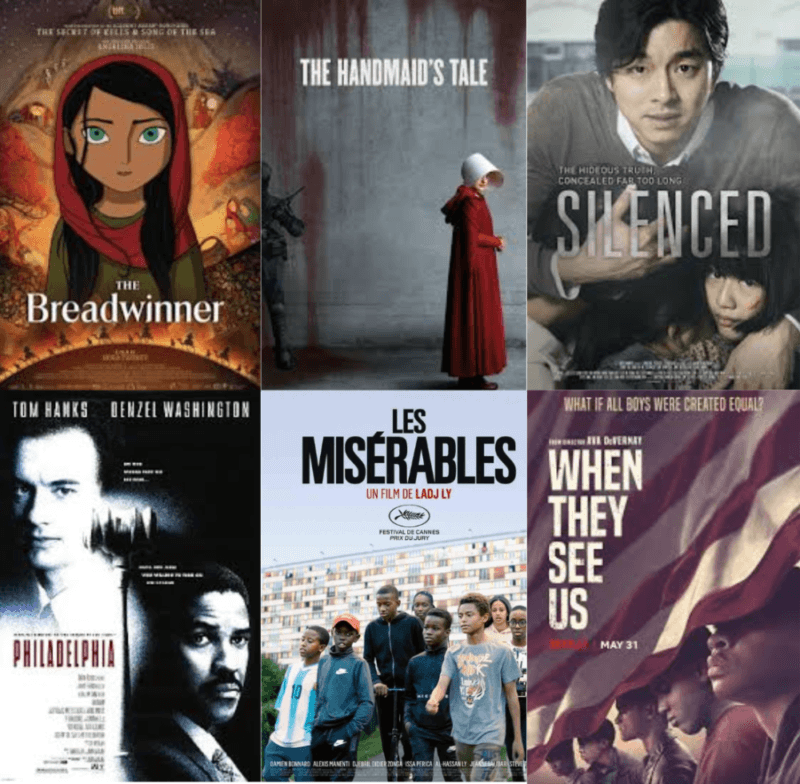
A good film does not simply say that a problem exists: it shows how it is embedded in people’s lives. In The Breadwinner, the right to education becomes a matter of survival for a young girl forced to disguise herself as a boy to go to school. In The Handmaid’s Tale, women’s rights and freedom of expression gradually disappear under a system of control and institutionalized violence. In Les Misérables, police violence unfolds through concrete situations of tension, checks, and escalation in a French suburb.
Other films show how rights can be weakened by systems themselves. In When They See Us, systemic racism and violations of the right to a fair trial appear through the arrest of minors and the manipulation of judicial truth. In Philadelphia, non-discrimination and human dignity take shape through the social and professional exclusion of a lawyer living with HIV.
What often strikes the viewer is not only the event itself, but its consequences: fear after police violence, trauma after war, precariousness after eviction, or silence after discrimination. Human rights violations thus appear as long-term processes, with deep and often invisible effects.
By transforming abstract principles into lived situations, cinema makes human rights tangible and enables a shift from theoretical understanding to emotional understanding. This staging of reality does not only make rights comprehensible; it also triggers an immediate emotional response.
II. Feeling Injustice Through Film
One of cinema’s greatest strengths is that it places emotion before analysis. Where a report or article allows one to intellectually understand a situation like war, discrimination, genocide, it does not always allow one to grasp its human dimension. Film, on the other hand, provokes an immediate reaction: anger, sadness, discomfort, empathy, or indignation.
This emotional dimension profoundly changes the perception of human rights. Feeling a situation already means beginning to understand it differently. The viewer is no longer simply informed: they are involved. Through characters, they are placed at the heart of lived experience. Injustice, violence, or humiliation become tangible realities.
Empathy plays a central role here. It transforms a distant reality into an almost personal experience: fear, helplessness, or pain become shareable, even if only briefly. This mechanism often enables a deeper awareness than a purely rational approach.
The South Korean film Silenced, based on real events, is a striking example. By exposing systemic violence committed against deaf children in an institution meant to protect them, it triggered strong public indignation, leading to social mobilization that resulted in legislative reform aimed at strengthening the protection of children with disabilities.
This example shows that cinema’s emotional impact can go beyond fiction and become a driver of collective awareness and social transformation.
Thus, by making injustice felt, cinema renders human rights violations impossible to ignore.
III. Uncovering the Many Faces of Human Rights Violations
Cinema does not limit itself to a single form of injustice: it reveals the diversity of human rights violations, whether systemic, social, political, or linked to armed conflict.
Some works highlight historical systems of domination and entrenched discrimination. 12 Years a Slave shows slavery as a structured system of dehumanization and exploitation. Parasite reveals extreme social inequalities and the invisible violence of class divides.
Other films address violence linked to armed conflict and collective trauma. The Pianist recounts survival in the Warsaw Ghetto and the progressive disappearance of all human and legal protection. Grave of the Fireflies illustrates the suffering of civilians, especially children, facing the direct consequences of war.
Institutional and social violence is also central in certain works. La Haine depicts tensions between suburban youth and law enforcement, revealing mechanisms of marginalization. A Silent Voice addresses school bullying and discrimination linked to disability as profound violations of human dignity.
Finally, films such as Just Mercy expose inequalities in the justice system and racial bias, as well as the death penalty, while The Story of Souleymane highlights administrative precariousness and the exploitation of migrant workers.
Cinema thus acts as a revealer of the multiple forms of human rights violations, showing both their visible and invisible, individual and structural logics. However, this representational power should not conceal the inherent limits of cinematic language.

IV. The Limits of Cinema
Cinema is a powerful tool, but it also has its limits. A film tells a story, not a comprehensive analysis. In order to capture attention and evoke emotion, it simplifies contexts and selects scenes, which helps understanding but reduces the real complexity of situations.
This is particularly visible in representations of humanitarian crises or armed conflicts. Cinema can show suffering and urgency, but it rarely explains in depth the historical, political, or legal causes. Films such as The Killing Fields strongly raise awareness of violence, but cannot fully capture its complexity.
Moreover, cinema is never neutral. It always carries a point of view, influenced by its production and distribution conditions. It can sometimes be embedded in soft power dynamics, shaping perceptions of certain international realities. Some Hollywood productions illustrate this, particularly superhero films, where the hero is often American and the enemy is associated with a foreign power, often Russian or portrayed with a Russian accent.
Finally, films can convey biases: simplification of roles, opposition between “good” and “evil,” cultural stereotypes, or excessive heroization of individuals. This can make situations more readable, but sometimes less nuanced.
Cinema should therefore be understood as an entry point into human rights: it raises awareness and evokes emotion, but does not replace in-depth legal, historical, and political analysis. Despite these limits, cinema remains a particularly effective tool when used for awareness-raising and advocacy.

V. Cinema as a Vehicle for Advocacy
Cinema plays a central role in human rights advocacy because it combines attention and emotion. Where a report may seem abstract, a film immediately captures attention and creates an emotional connection with the situations presented.
It especially helps open up debate. After a screening, one can question the issues: which rights are being violated? Who is vulnerable? Who holds power? What does the film reveal about society? And what could be changed in reality? Cinema thus becomes a tool of civic education.
Many organizations such as the United Nations Human Rights Office, UNESCO, or Amnesty International[1] use audiovisual tools in their campaigns because they facilitate understanding and strengthen public engagement.
Engaged cinema extends this dynamic by directly giving voice to on-the-ground realities. Films such as No Other Land or The Voice of Hind Rajab bear witness to situations of conflict, forced displacement, and violence suffered by civilians, particularly children in the occupied Palestinian territories. They do not merely tell stories: they alert and challenge.
Thus, cinema does not only show: it can trigger awareness, encourage engagement, and support concrete action.
Conclusion
Films do not replace legal texts or expert analysis. Their role is different, but essential: they give a human face to human rights, make their issues more concrete, and render visible violations that are often abstract.
Going to the cinema is therefore not only about entertainment. It can also constitute a first opening toward understanding the world and its injustices.
[1] Article, Amnesty International, “The best human rights films”, 8/06/2017, here.
Cinema does not claim to teach human rights in an exhaustive way, but it often constitutes the first step. By transforming abstract notions into lived narratives, by mobilizing emotion, and by revealing the diversity of injustices, it makes these issues more accessible.
However, this awareness is not sufficient in itself. Cinema can initiate reflection, raise questions, and awaken sensitivity. It is then up to each individual to extend this movement, deepen their understanding, and perhaps transform this awareness into engagement.
Sarah Pereira
Projekti prostovoljstva v okviru Evropske solidarnostne enote mladim nudijo priložnosti za prostovoljsko delo. Odgovarjati morajo na pomembne potrebe družbe, prispevati h krepitvi skupnosti in ob tem prostovoljcem omogočati, da pridobivajo uporabne izkušnje, veščine in kompetence za svoj osebni, izobraževalni, socialni, državljanski in profesionalni razvoj, s čimer se izboljšuje njihova zaposljivost.
Več o programu Evropske solidarnostne enote (slo. ESE, ang. ESC, bivši EVS) si lahko preberete na povezavi: http://www.movit.si/ese/projekti-prostovoljstva/